Refillable Pouches Market Growth in Pet Food Packaging
>100 Views
August 14, 25
スライド概要
The global refillable pouches market is poised for significant expansion, projected to grow from USD 3.3 billion in 2025 to USD 5.2 billion by 2035, exhibiting a robust Compound Annual Growth Rate (CAGR) of 4.6%. This substantial growth signals a critical opportunity for manufacturers, positioning refillable pouches as a strategic solution to address core challenges in efficiency, cost management, and environmental responsibility.
Request Refillable Pouches Market Draft Report: https://www.futuremarketinsights.com/reports/sample/rep-gb-22429
In an era defined by increasing material costs, supply chain complexities, and heightened demand for sustainable practices, manufacturers are actively seeking innovative packaging solutions. Refillable pouches offer a compelling answer, enabling reduced material consumption, lighter shipping weights, and seamless integration into circular economy models. Their versatility across personal care, home care, and food packaging, coupled with continuous advancements in material science and filling technologies, makes them an essential component for forward-thinking brands.
Unlocking Manufacturer Advantages with Refillable Pouches
Refillable pouches are rapidly gaining traction due to their inherent benefits: low material usage and compatibility with refill models. These formats, ranging from stand-up pouches with spouts to collapsible bags, are engineered for repeated use, directly supporting manufacturers' goals of resource optimization. Currently, refillable pouches account for an estimated 4.2% share of the global flexible packaging market, steadily expanding their presence.
Sierra Liggett, Division Manager at PAC Worldwide, highlights this transformative shift, describing refill pouches as a "strategic inflection point where performance and environmental responsibility can align." She emphasizes the development of advanced film technologies that ensure zero leakage, a critical factor for liquid and semi-liquid products. Furthermore, these pouches significantly reduce shipping weight by an impressive 66%, directly contributing to lower transport-related emissions and material usage. This demonstrates that manufacturers can achieve substantial environmental benefits without compromising product integrity or functionality, reinforcing a commitment to practical solutions across the supply chain.
Key Segments Driving Manufacturing Innovation
Several segments within the refillable pouches market offer distinct advantages for manufacturers:
• Zipper Closures: Reliability and Consumer Retention With a dominant 55% market share in 2025, zipper closures are a leading format, crucial for personal care, food, and home cleaning products requiring repeated access. Manufacturers like Glenroy, Constantia Flexibles, and ProAmpac provide custom zipper formats, including tamper-evident options. Zippers tested for over 10 open-close cycles maintain 95% sealing integrity, directly enhancing customer retention for refill SKUs. These pouches boast lower failure rates than spouts (<2% in burst testing) and support recyclable mono-material options, ensuring both reliability and efficient production speeds of 50-65 pouches/min on VFFS lines.
• Personal Care: A High-Demand End-Use Personal care applications constitute a significant 49% of refill pouch demand, driven by products such as shower gels and shampoos. Brands like L’Oréal, Unilever, and Procter & Gamble are widely adopting these pouches. Manufacturers benefit from solutions designed for chemical compatibility (pH 4-9), robust surface print adhesion, and material flexibility for viscous fluids. Refill packs are engineered to resist up to 3N tear strength, ensuring durability throughout consumer use and shelf life.
• PE-Based Films: Performance and Recyclability PE (Polyethylene) remains the preferred pouch material, holding an estimated 48% share, valued for its heat seal compatibility, impact strength, and increasing availability of mono-material variants. High-performance PE films offer puncture resistance above 1.5 N/mm and minimal delamination. Suppliers like Amcor, Sealed Air, and Coveris provide recyclable PE structures. These films also enable downgauging up to 20% without compromising form stability, offering significant material cost reductions for manufacturers.
Browse the Complete Report! https://www.futuremarketinsights.com/reports/refillable-pouches-market
Navigating Market Dynamics for Operational Excellence
The refillable pouches market is characterized by dynamic shifts that directly influence manufacturers' operational strategies:
• Inventory Optimization: Brands are actively reducing pouch inventory holding times to ease warehouse congestion and free up capital. This move towards demand-linked replenishment has seen holding times in Western European facilities drop from 74 to 52 days. Modular pouch-filling units are enabling 19% lower minimum order sizes, supporting quicker replenishment cycles and reducing stock-out incidents by 13%. This translates to leaner, more responsive supply chains for manufacturers.
• Format Validation and Expansion: Extensive trials confirm the functional integrity and consumer acceptance of refillable pouches across diverse product categories. A 2024 trial found multilayer PE pouches retained 94% functional integrity after five refill rounds for toiletries, while Australian brands saw 17% growth in refill-pack units for frozen soups. These validations provide manufacturers with confidence to expand their refillable product lines.
• Margin Management: Despite pressures from rising resin and freight costs, manufacturers are adopting strategies to maintain profitability. This includes utilizing mono-material structures with thinner films (trimming material costs by 11%) and introducing fixed-price refill bundles. Such proactive measures ensure financial stability amidst market volatility.

Future Market Insights is the premier provider of market intelligence and consulting services, serving clients in over 150 countries. FMI is headquartered in Delaware, USA, and has its global delivery center in India. In addition to these, FMI also carries out business development and client engagement through its UK and UAE offices.
関連スライド

エシカルデータの潮流
 tokoroten
82.6K
tokoroten
82.6K


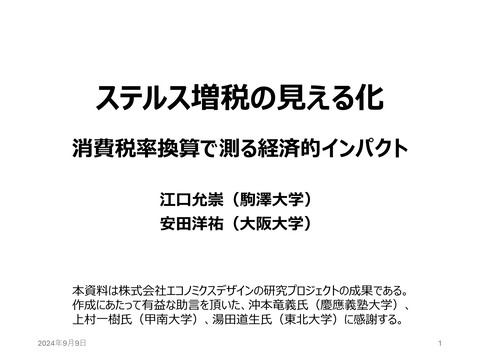
ステルス増税の見える化
 安田 洋祐
19.3K
安田 洋祐
19.3K




各ページのテキスト
Refillable Pouches Emerge as Strategic Imperative for Manufacturers, Driving Growth and
Sustainability
Global Market Set to Reach USD 5.2 Billion by 2035, Offering Solutions for Efficiency, Cost, and
Environmental Goals
The global refillable pouches market is poised for significant expansion, projected to grow from USD
3.3 billion in 2025 to USD 5.2 billion by 2035, exhibiting a robust Compound Annual Growth Rate
(CAGR) of 4.6%. This substantial growth signals a critical opportunity for manufacturers, positioning
refillable pouches as a strategic solution to address core challenges in efficiency, cost management,
and environmental responsibility.
In an era defined by increasing material costs, supply chain complexities, and heightened demand
for sustainable practices, manufacturers are actively seeking innovative packaging solutions.
Refillable pouches offer a compelling answer, enabling reduced material consumption, lighter
shipping weights, and seamless integration into circular economy models. Their versatility across
personal care, home care, and food packaging, coupled with continuous advancements in material
science and filling technologies, makes them an essential component for forward-thinking brands.
Unlocking Manufacturer Advantages with Refillable Pouches
Refillable pouches are rapidly gaining traction due to their inherent benefits: low material usage and
compatibility with refill models. These formats, ranging from stand-up pouches with spouts to
collapsible bags, are engineered for repeated use, directly supporting manufacturers' goals of
resource optimization. Currently, refillable pouches account for an estimated 4.2% share of the
global flexible packaging market, steadily expanding their presence.
Sierra Liggett, Division Manager at PAC Worldwide, highlights this transformative shift, describing
refill pouches as a "strategic inflection point where performance and environmental responsibility
can align." She emphasizes the development of advanced film technologies that ensure zero
leakage, a critical factor for liquid and semi-liquid products. Furthermore, these pouches significantly
reduce shipping weight by an impressive 66%, directly contributing to lower transport-related
emissions and material usage. This demonstrates that manufacturers can achieve substantial
environmental benefits without compromising product integrity or functionality, reinforcing a
commitment to practical solutions across the supply chain.
Key Segments Driving Manufacturing Innovation
Several segments within the refillable pouches market offer distinct advantages for manufacturers:
•

Zipper Closures: Reliability and Consumer Retention With a dominant 55% market share in
2025, zipper closures are a leading format, crucial for personal care, food, and home
cleaning products requiring repeated access. Manufacturers like Glenroy, Constantia
Flexibles, and ProAmpac provide custom zipper formats, including tamper-evident options.
Zippers tested for over 10 open-close cycles maintain 95% sealing integrity, directly
enhancing customer retention for refill SKUs. These pouches boast lower failure rates than
spouts (<2% in burst testing) and support recyclable mono-material options, ensuring both
reliability and efficient production speeds of 50-65 pouches/min on VFFS lines.

•

Personal Care: A High-Demand End-Use Personal care applications constitute a significant
49% of refill pouch demand, driven by products such as shower gels and shampoos. Brands
like L’Oréal, Unilever, and Procter & Gamble are widely adopting these pouches.
Manufacturers benefit from solutions designed for chemical compatibility (pH 4-9), robust surface print adhesion, and material flexibility for viscous fluids. Refill packs are engineered to resist up to 3N tear strength, ensuring durability throughout consumer use and shelf life. • PE-Based Films: Performance and Recyclability PE (Polyethylene) remains the preferred pouch material, holding an estimated 48% share, valued for its heat seal compatibility, impact strength, and increasing availability of mono-material variants. High-performance PE films offer puncture resistance above 1.5 N/mm and minimal delamination. Suppliers like Amcor, Sealed Air, and Coveris provide recyclable PE structures. These films also enable downgauging up to 20% without compromising form stability, offering significant material cost reductions for manufacturers. Request Refillable Pouches Market Draft Report: https://www.futuremarketinsights.com/reports/sample/rep-gb-22429 For more on their methodology and market coverage, visit! https://www.futuremarketinsights.com/about-us Navigating Market Dynamics for Operational Excellence The refillable pouches market is characterized by dynamic shifts that directly influence manufacturers' operational strategies: • Inventory Optimization: Brands are actively reducing pouch inventory holding times to ease warehouse congestion and free up capital. This move towards demand-linked replenishment has seen holding times in Western European facilities drop from 74 to 52 days. Modular pouch-filling units are enabling 19% lower minimum order sizes, supporting quicker replenishment cycles and reducing stock-out incidents by 13%. This translates to leaner, more responsive supply chains for manufacturers. • Format Validation and Expansion: Extensive trials confirm the functional integrity and consumer acceptance of refillable pouches across diverse product categories. A 2024 trial found multilayer PE pouches retained 94% functional integrity after five refill rounds for toiletries, while Australian brands saw 17% growth in refill-pack units for frozen soups. These validations provide manufacturers with confidence to expand their refillable product lines. • Margin Management: Despite pressures from rising resin and freight costs, manufacturers are adopting strategies to maintain profitability. This includes utilizing mono-material structures with thinner films (trimming material costs by 11%) and introducing fixed-price refill bundles. Such proactive measures ensure financial stability amidst market volatility. Editor’s Note: This release is based exclusively on verified and factual market content derived from industry analysis by Future Market Insights. No AI-generated statistics or speculative data have been introduced. This press release highlights significant shifts in the Refillable Pouches Market, which is experiencing a pivotal change driven by consumer demand for healthier, more transparent products. Related Reports: Asia Pacific and Europe Tarpaulin Sheets Market: https://www.futuremarketinsights.com/reports/asia-pacific-and-europe-tarpaulin-sheets-market
Global PP Closure Market: https://www.futuremarketinsights.com/reports/global-pp-closure-market Canada Straws Market: https://www.futuremarketinsights.com/reports/canada-straws-market About Future Market Insights (FMI) Future Market Insights, Inc. (ESOMAR certified, recipient of the Stevie Award, and a member of the Greater New York Chamber of Commerce) offers profound insights into the driving factors that are boosting demand in the market. FMI stands as the leading global provider of market intelligence, advisory services, consulting, and events for the Packaging, Food and Beverage, Consumer Technology, Healthcare, Industrial, and Chemicals markets. With a vast team of over 400 analysts worldwide, FMI provides global, regional, and local expertise on diverse domains and industry trends across more than 110 countries. Join us as we commemorate 10 years of delivering trusted market insights. Reflecting on a decade of achievements, we continue to lead with integrity, innovation, and expertise. Contact Us: Future Market Insights Inc. Christiana Corporate, 200 Continental Drive, Suite 401, Newark, Delaware – 19713, USA T: +1-347-918-3531 For Sales Enquiries: [email protected] Website: https://www.futuremarketinsights.com LinkedIn| Twitter| Blogs | YouTube
- https://www.futuremarketinsights.com/reports/global-pp-closure-market
- https://www.futuremarketinsights.com/reports/canada-straws-market
- https://www.futuremarketinsights.com/
- https://www.linkedin.com/company/future-market-insights/
- https://twitter.com/FMI_Research
- https://www.futuremarketinsights.com/blogs
- https://www.youtube.com/@Futuremarketinsights